Karlheinz Böhm, Moira Shearer, Anna Massey, Maxine Audley, Brenda Bruce, Miles Malleson, Esmond Knight, Martin Miller, Michael Goodliffe, Jack Watson, Shirley Anne Field
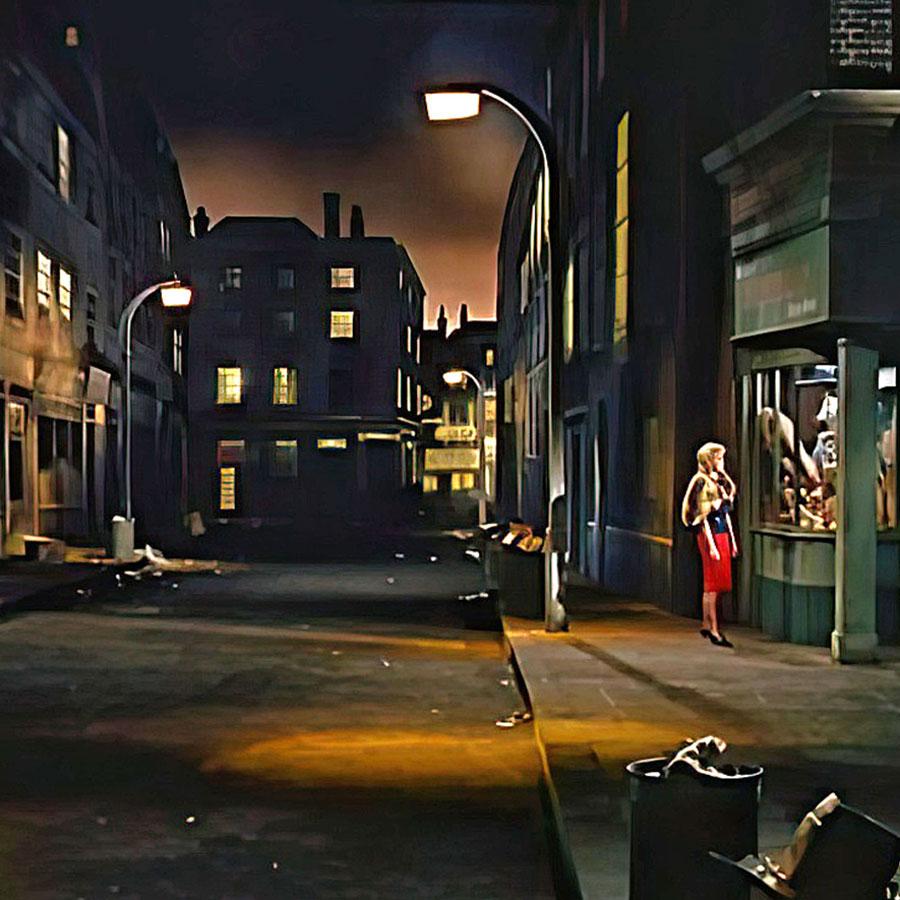
A surreal, abandoned London street serves as backdrop for the first murder.
Mark Lewis (Carl Boehm) spies on the party hosted by his downstairs neighbors.
“Whatever I photograph I always lose.” There was probably no chance for Michael Powell’s Peeping Tom to make its mark on contemporary cinema given its U.S. release just three months after Alfred Hitchcock’s Psycho, a far superior psycho-sexual masterpiece that not only shocked and captivated 1960 audiences but profoundly influenced moviemaking for subsequent generations. Both films share a radical-for-the-time premise linking parental abuse to serial killer tendencies; while Psycho famously centers on Norman Bates’ mother, Peeping Tom features a scientist father using his little boy for psychological experiments about fear and voyeurism. From its opening sequence in which that little boy grown up, soft-spoken Soho photographer Mark Lewis (Carl Boehm), films a prostitute with his handheld camera (still a novelty for the time period) as he solicits her business, follows her up to her flat, and murders her, we’re immersed in an artistic work, one where modern sensory details will be carefully crafted to elicit complex psychological reactions (Powell’s use of humming sound effects predates David Lynch’s mastery of aural surrealism, and Frank’s concealed darkroom way in the back of his flat doubles as a kind of torture chamber and for some viewers might even conjure The Silence of the Lambs). Concealing a long blade inside one of his tripod’s legs, Lewis strokes his camera and even groans sexually as he later films the authorities as they discover his victims’ bodies, including that of dancer Vivian (Moira Shearer) whose corpse is stuffed in a trunk on a studio set late one night. A plain-looking Anna Massey plays 21-year-old neighbor Helen Stephens, who lives downstairs with her vision-impaired but highly perceptive mother (“The blind always live in the rooms they live under”) and takes a maybe-romantic interest in Mark, whom she first meets when she catches him, true to form, peeking inside her window.
Rate+Review Peeping Tom
You must be logged in to submit a review. You may also register for an account.